


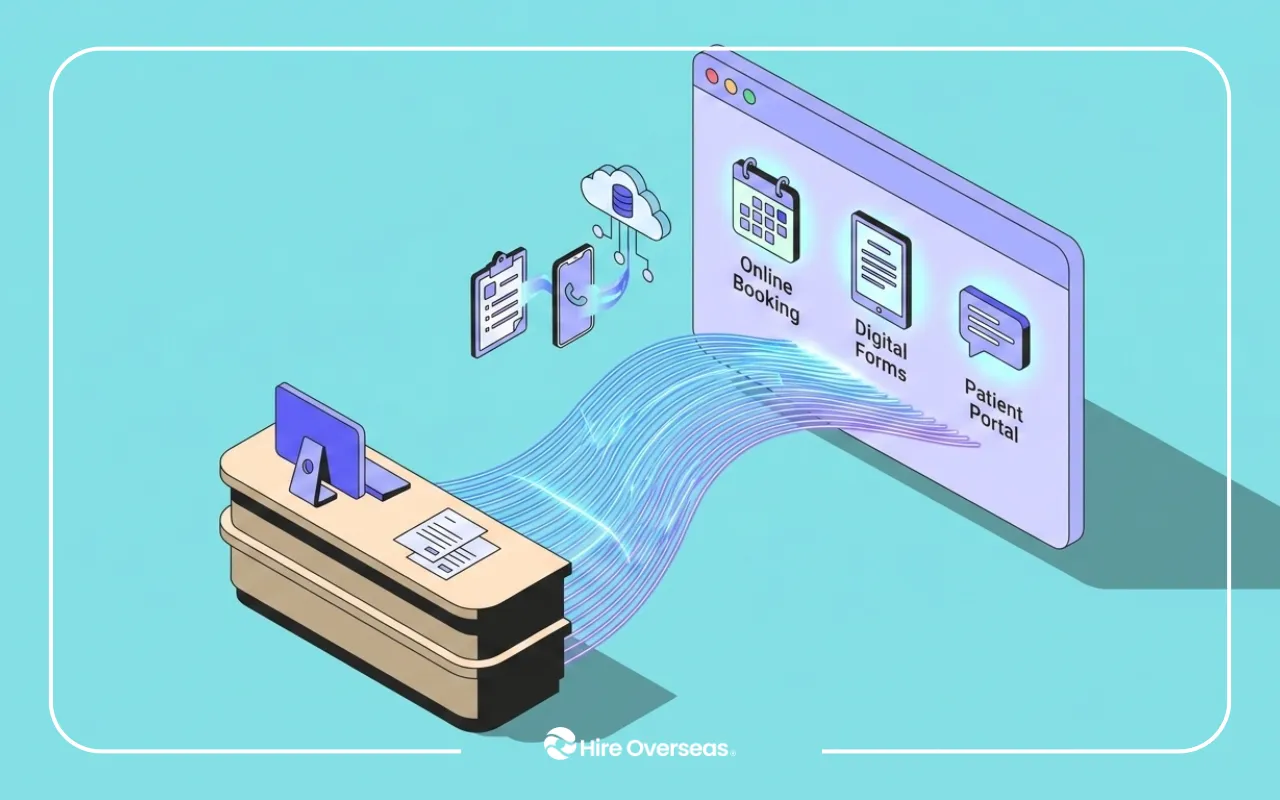
For decades, the front desk served as the primary gateway between patients and providers. Patients checked in, completed paperwork, scheduled appointments, and asked questions—all through a receptionist. Today, that gateway extends far beyond the office. Patients schedule appointments online, complete digital intake forms, communicate through portals, and often interact with practices before ever arriving in person. As healthcare evolves, the front desk is becoming less about a physical location and more about managing patient access across multiple channels. This shift has increased the value of virtual medical receptionists, who help coordinate communication, scheduling, and patient interactions to ensure a smoother experience from the very first point of contact.
The Front Desk Has Changed More Than Most Practices Realize
One of the most interesting observations we've made while working with healthcare organizations is that many practices still think about the front desk as a place rather than a function. Historically, that assumption made sense. Most patient interactions happened inside the clinic. Patients arrived, checked in, asked questions, updated information, and scheduled future appointments while standing in front of a receptionist. Today, many of those same interactions happen before a patient ever walks through the door.
Patients may:
- call to schedule appointments
- submit online intake forms
- request prescription refills
- ask insurance questions
- communicate through patient portals
- schedule telehealth visits
- respond to appointment reminders
As these communication channels have expanded, patient access has become far more distributed than it was in the past.
One healthcare administrator we spoke with described it this way:
"The front desk used to manage people standing in front of us. Now it manages conversations happening everywhere."
That observation reflects a broader shift occurring across healthcare. The front desk still exists, but its responsibilities increasingly extend beyond the physical office. As a result, practices are beginning to rethink how patient access functions are staffed, managed, and supported.
If your practice is evaluating what virtual front-desk support actually covers day-to-day, this overview of virtual receptionist services breaks down the specific administrative tasks handled remotely versus in-person.
Recognizing the Signs of Patient Access Challenges
One pattern we've consistently observed at Hire Overseas is that practices rarely begin exploring virtual medical receptionist support because they set out to outsource their front desk. Instead, they start noticing small operational issues that gradually become harder to ignore. What begins as an occasional missed call or scheduling delay can eventually affect patient satisfaction, staff morale, and overall practice efficiency.
Patients Struggle to Reach the Practice
For many practices, the earliest warning signs involve communication.
- Calls go unanswered during busy periods.
- Patients spend longer on hold.
- Voicemails begin piling up.
- Response times stretch from hours to days.
While these issues may seem minor at first, they directly affect how easily patients can access care. For patients seeking appointments, answers to insurance questions, or follow-up information, responsiveness often shapes their first impression of the practice.
Appointment Scheduling Becomes a Bottleneck
As communication volumes increase, scheduling often becomes the next challenge.
- Appointment requests take longer to process.
- Rescheduling becomes more complicated.
Front-office staff spend more time managing calendars and less time assisting patients.
What appears to be a scheduling problem is often a symptom of a larger patient access issue. When communication channels become overloaded, even routine scheduling tasks can create delays that ripple throughout the patient experience.
Reception Teams Are Asked to Do More With the Same Resources
Eventually, the pressure reaches the reception team itself. Staff members juggle phone calls, patient questions, insurance verification, referral coordination, intake paperwork, and appointment management simultaneously.
- A dermatology clinic may receive hundreds of appointment inquiries each week.
- A behavioral health practice may spend significant time coordinating intake paperwork and patient follow-ups.
- A multi-provider primary care clinic may be managing scheduling requests, referral coordination, insurance verification, and patient questions all at once.
In each case, patient communication demands have increased even when provider capacity has remained relatively stable. As practices adopt more communication channels and patients expect faster responses, the workload placed on reception teams often grows significantly without a corresponding increase in support.
Practices managing billing questions alongside scheduling and intake often find that outsourced medical billing removes one of the heaviest administrative layers from the front-office queue.
The Challenge Is Often Capacity, Not Staffing
At first, many practices assume they simply need another receptionist. However, after speaking with healthcare leaders across different specialties, we've found that the underlying issue is often broader than staffing alone. One practice owner told us they initially planned to hire another in-office receptionist. After evaluating where communication was actually occurring, they realized much of the workload involved phone calls, appointment coordination, and patient communication that did not require an onsite employee. The issue was not necessarily the absence of staff.
The issue was that patient access workflows had outgrown the existing front-office structure. In other words, the practice had reached a capacity challenge rather than a simple hiring challenge. The systems supporting patient communication were no longer keeping pace with demand.
Practices that recognize this distinction early are often able to address communication bottlenecks before patient experience begins suffering.
For multi-specialty clinics managing documentation volume alongside front-desk load, this guide to medical scribe services explains how remote scribes reduce the documentation burden on clinical and administrative staff simultaneously.
Why Virtual Medical Receptionists Are Becoming Part of the Patient Experience
Many practices still think of reception as an administrative function. From the patient's perspective, however, reception often shapes the first experience of care. Before a patient meets a provider, they may already have called the office, scheduled an appointment, asked about insurance, completed intake forms, rescheduled a visit, or followed up on a referral. Each interaction affects how accessible, organized, and responsive the practice feels. This is why the role of the virtual medical receptionist has become more important as patient communication has expanded beyond the physical front desk.
Responsiveness Shapes the First Impression
For many patients, the first impression of a practice does not happen in the exam room.
It happens when they call to schedule an appointment, ask a question, or request clarification before a visit. If the call is answered quickly, the patient feels guided.
If the call goes unanswered or is returned days later, the patient may begin questioning whether the practice is organized enough to meet their needs.
One clinic leader we've worked with described patient calls as "the front door patients use before the actual front door." That is exactly why responsiveness matters. A virtual medical receptionist helps ensure patient inquiries are handled consistently, especially during peak call periods, lunch breaks, staff absences, or after-hours windows.
Scheduling Is Part of the Care Experience
Appointment scheduling may seem administrative, but patients often experience it as part of their care journey. A delayed appointment response can feel like delayed access to care. A confusing scheduling process can create frustration before the visit even happens.
A smooth scheduling experience, on the other hand, creates confidence that the practice is attentive and organized. Virtual medical receptionist services that handle patient scheduling and intake help reduce friction at one of the most important access points in the patient journey. This is especially valuable for private practices and multi-provider clinics where calendars, provider availability, appointment types, and patient preferences all need to be coordinated accurately.
Intake Accuracy Affects the Entire Visit
Patient intake is another area where reception work directly affects clinical flow. Incomplete forms, missing demographic information, incorrect insurance details, or unclear visit reasons can create delays for providers and frustration for patients.
Virtual medical receptionists can support:
- patient intake
- demographic updates
- insurance verification
- referral coordination
- basic EHR data entry
- appointment preparation
When this information is captured accurately before the appointment, the visit can run more smoothly. This is where virtual medical receptionists differ from medical scribes. Scribes support documentation during the clinical encounter. Receptionists support patient access before the encounter begins.
After-Hours Calls Can Still Affect Patient Trust
Patient communication does not always happen during office hours. Patients may call after work, during evenings, or on weekends to request appointments, ask questions, cancel visits, or leave messages. For busy medical offices, unanswered after-hours calls can create missed opportunities and delayed communication. This is one reason some practices explore 24/7 virtual medical receptionist services for after-hours calls. The goal is not necessarily to replace the in-office team, but to extend patient access when the physical front desk is unavailable.
In our experience, practices that invest in after-hours responsiveness often do so because they understand that patient trust is built through availability, not just clinical quality.
Why More Practices Are Building Patient Access Systems Instead of Reception Teams
One of the most interesting shifts we've observed across healthcare practices is that many organizations are no longer thinking about patient communication as a staffing problem. They are thinking about it as a systems problem. Historically, when patient demand increased, practices often responded by adding another receptionist. More calls meant more front-office staff. More appointments meant more people managing schedules and patient inquiries. Today, the challenge is often more complex.
Patient Communication No Longer Happens in One Place
Patients communicate through multiple channels. Appointment requests arrive through websites, patient portals, phone calls, text messages, and telehealth platforms. Questions can come in before, during, and after business hours. A single patient journey may involve scheduling, intake, insurance verification, referral coordination, reminders, and follow-up communication. As communication becomes more distributed, managing patient access requires more than simply staffing a physical front desk.
For telehealth-enabled practices in particular, this breakdown of telehealth virtual assistant support covers how remote staff handle patient intake, scheduling, and follow-up coordination across digital visit workflows.
Practices Need Outcomes, Not Just Headcount
Many practices eventually discover that adding another receptionist does not always solve the underlying issue. The real goal is not hiring receptionists.
The goal is ensuring that:
- calls are answered
- appointments are scheduled
- patients receive timely responses
- intake processes move efficiently
- communication remains consistent
In other words, practices increasingly need reliable patient access systems rather than additional front-desk capacity alone.
Scalability Depends on Process as Much as People
One healthcare administrator we spoke with explained that their biggest challenge was not staffing the front desk. It was creating a communication process that could keep pace with growing patient demand. The practice eventually realized that patient access depended on workflows, coverage, responsiveness, and coordination just as much as it depended on headcount.
This is a pattern we've observed repeatedly. As practices grow, patient communication becomes more difficult to manage through staffing alone. Sustainable growth often requires systems that can support increasing demand without creating communication bottlenecks.
Virtual Medical Receptionists Support the System
This is one reason virtual medical receptionists are becoming more common within modern healthcare operations. They allow practices to add capacity where patient communication is actually occurring rather than limiting support to a physical front desk.
Rather than viewing virtual receptionists as a replacement for traditional reception teams, many healthcare organizations view them as part of a broader patient access strategy designed to improve responsiveness, increase coverage, and support a growing volume of patient interactions.
The organizations adapting most successfully are often the ones that stop asking, "Do we need another receptionist?" and start asking, "How do we create a patient access system that can scale with the practice?"
That shift in thinking may ultimately define the future of front-office healthcare operations.
For practices trying to determine whether their situation calls for an additional hire or a structural workflow fix, this overview of healthcare outsourcing covers how other organizations have separated staffing decisions from capacity decisions.
The Front Desk Is No Longer Defined by Location
One of the biggest shifts occurring in healthcare is not clinical. It is operational.
The way patients access care is changing. Appointments no longer begin when a patient walks into a clinic. They begin with a phone call, an online booking request, a portal message, or a question submitted through a website. Long before a provider enters the picture, patients are already forming opinions about how accessible, responsive, and organized a practice feels. That is why the role of the front desk is evolving. What was once a physical location inside a medical office is increasingly becoming a patient access function that extends across multiple communication channels, workflows, and touchpoints.
The practices adapting most successfully are recognizing that patient access is no longer measured by how many receptionists sit behind a desk. It is measured by how effectively patients can reach care, receive support, and navigate the healthcare experience from their very first interaction.
If you're looking to build a more scalable patient access operation, book a discovery call with Hire Overseas to explore how dedicated virtual medical receptionists can help strengthen communication, improve responsiveness, and support a better patient experience as your practice grows.
