


Choosing between freelancers and hiring overseas contractors is no longer a tactical decision. It is a structural one. The remote hiring model you choose determines execution quality, accountability, and how much operational drag your company absorbs over time.
This guide breaks down hire overseas vs. freelancers from the perspective of founders and operators building long-term capacity, not short-term output.
Understanding the Two Models at a Structural Level
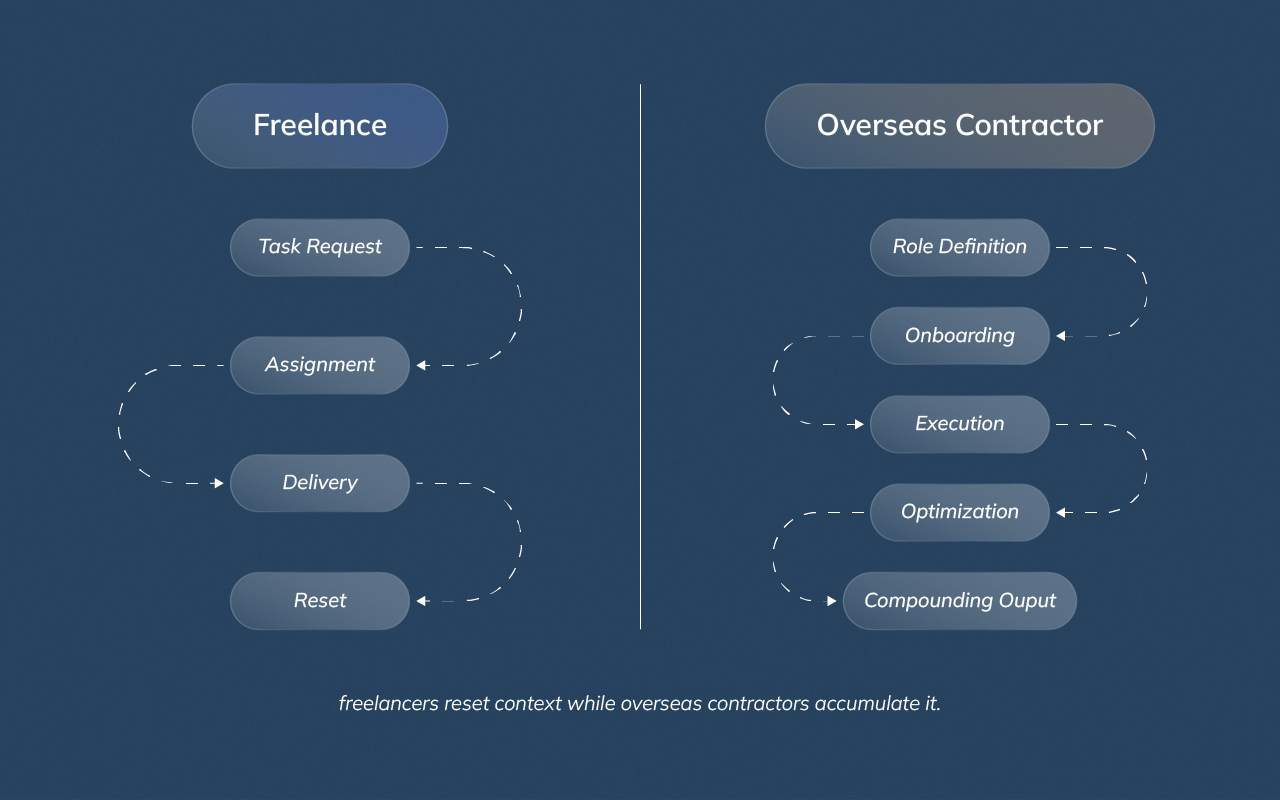
Before comparing cost or speed, it helps to understand how these models actually operate inside a business.
Freelancers
Freelancers are independent workers hired for task-based or project-based work. They typically support multiple clients at once and operate outside your company’s internal structure.
Overseas Contractors
Overseas contractors are full-time, dedicated professionals based outside your home country. They work exclusively with your company but are engaged compliantly as contractors, not employees.
This distinction is why overseas hiring vs. freelancers is less about geography and more about commitment and ownership.
Confused about how outsourcing differs from offshoring in practice?
Read more: Outsourcing vs Offshoring — What Actually Changes Operationally
Hire Overseas vs. Freelancers: Core Differences That Matter
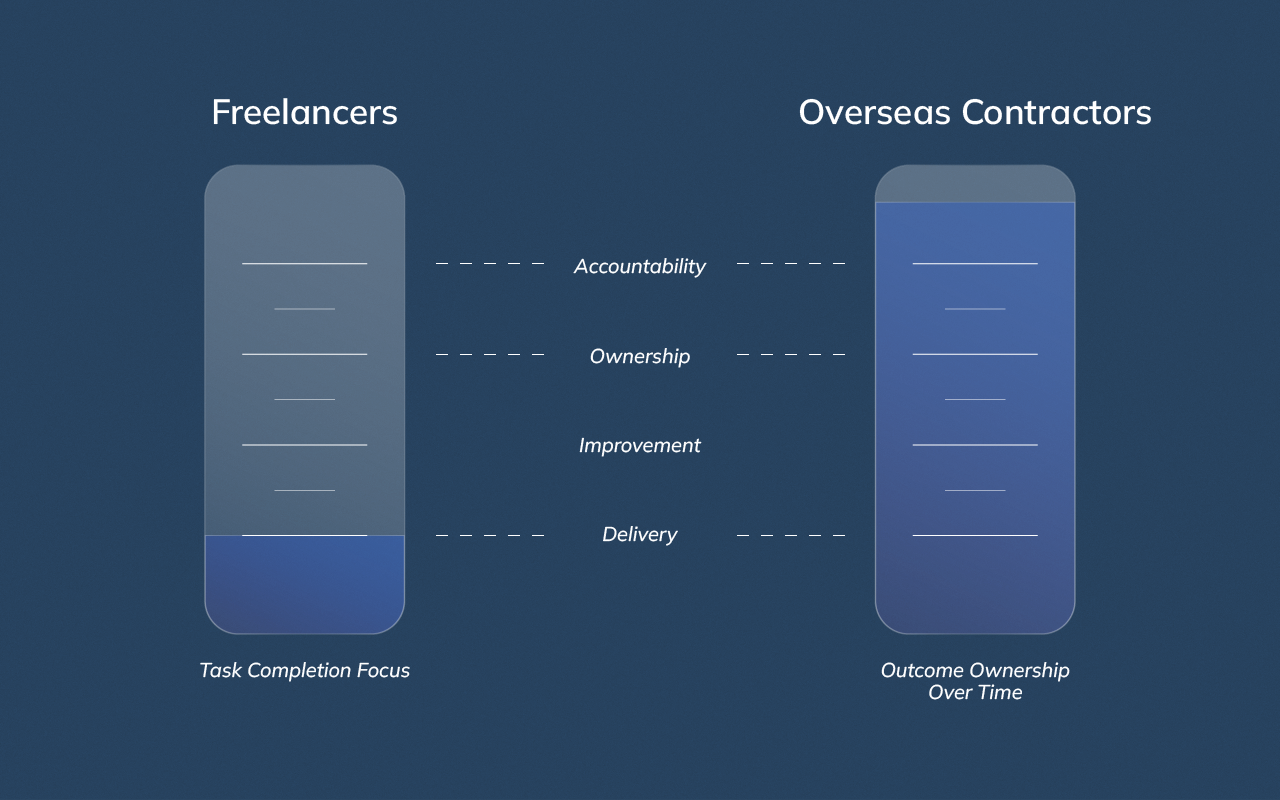
Accountability and Ownership
Freelancers
- Optimize for flexibility and independence
- Accountability is limited to the scope of a task or project
- Availability can shift without notice as priorities change across clients
- Work is completed to spec, but ownership typically ends at delivery
Overseas Contractors
- Optimize for consistency and long-term contribution
- Operate on fixed schedules aligned with your business hours
- Follow internal priorities set by managers and team leads
- Take ownership of outcomes, not just individual deliverables
This difference sits at the core of overseas workers vs.. freelancers hiring decisions. One model supports task completion. The other supports sustained execution.
Integration Into Distributed Teams
Freelancers
- Typically sit outside daily operations
Are looped in when work is assigned and removed once tasks are complete - Limited exposure to internal tools, processes, and decision-making
Overseas Contractors
- Are embedded into distributed teams from day one
- Attend regular check-ins and planning sessions
- Follow SOPs and documented workflows
- Improve processes over time as context accumulates
As collaboration increases, companies comparing overseas teams vs. freelancers usually find freelancers harder to manage at scale.
Clear communication is non-negotiable in distributed teams.
Read more: How to Assess the English Skills of Offshore Talent
Cost Predictability vs. Cost Illusion
Freelancers
- Often appear cheaper upfront
- Hourly or per-project rates feel flexible
- True costs are fragmented across rework, delays, inconsistent availability, and repeated onboarding
Overseas Contractors
- Offer predictable monthly costs
- Availability, workload, and expectations are clearly defined
- Budgeting becomes simpler as roles stabilize over time
This is where hiring offshore vs. freelancers becomes a budgeting and planning decision, not just a sourcing one.
Role Depth and Continuity
Freelancers
- Perform best in narrow, well-defined scopes
- Require frequent context resets as projects change
Overseas Contractors
- Excel in roles that evolve over time
- Build institutional knowledge and role-specific judgment
- Add the most value in operations, customer support, admin, marketing execution, and technical support
This is why freelance vs. full-time overseas workers comparisons often miss the operational cost of resetting context again and again.
Overseas Staffing vs. Freelancing: Operational Trade-Offs
This is why companies transitioning out of early-stage execution move from freelancing to overseas staffing models.
Managed Overseas Hiring vs. Freelancers
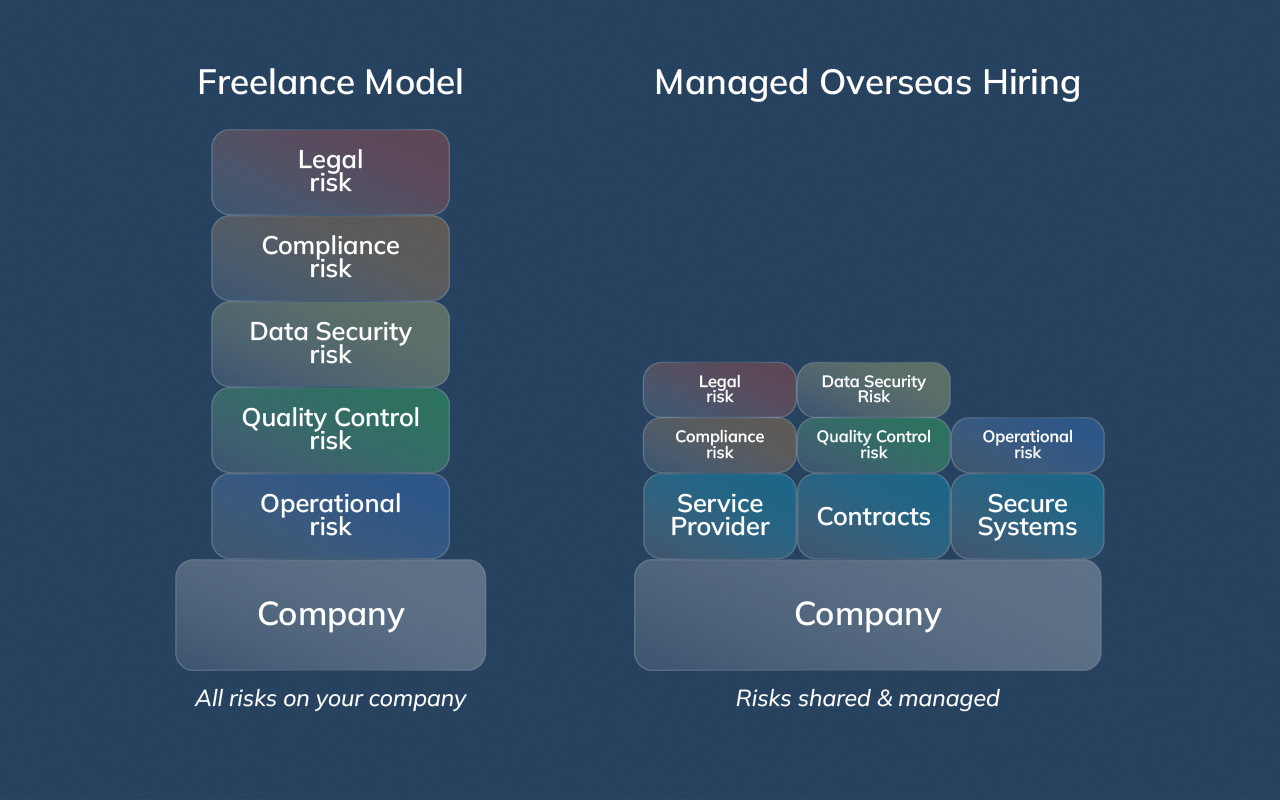
As companies grow past one-off tasks, the decision is no longer just about who does the work. It becomes about how much operational risk the company is willing to carry.
Freelancers
- Are sourced and managed individually
- Operate under generic platform contracts or ad hoc agreements
- Require the company to handle vetting, onboarding, and continuity
- Create exposure when availability changes or a contractor disengages
Managed Overseas Hiring
- Provides dedicated overseas contractors within a structured model
- Uses proper contractor engagement frameworks designed for international work
- Handles contracts, payments, and local compliance considerations
- Provides continuity and replacements so roles do not reset
In the context of hiring overseas vs. freelancers, this comparison matters because freelancers feel safer by default, even when they introduce long-term instability.
However, managed overseas hiring removes the trade-off between control and compliance. Companies gain consistent execution without taking on the legal, operational, and administrative burden of managing overseas contractors on their own.
However, this does not mean freelancers stop being useful.
When Freelancers Still Make Sense
Even with a managed overseas hiring model in place, freelancers remain a practical tool when the work itself does not require continuity.
They perform best when:
- Work is short-term or experimental
- Output is isolated and non-recurring
- Speed matters more than integration
- Specialized expertise is needed for a limited window
In these cases, freelancers provide flexibility without adding unnecessary structure.
The mistake is not using freelancers. The mistake is relying on them for roles that require consistent availability, growing context, and long-term ownership.
This distinction sets up why founders eventually shift from freelancers toward dedicated overseas contractors for core execution, which is what they experience firsthand.
When Hiring Overseas Contractors Wins Long-Term
Freelancers are effective for flexibility. Overseas contractors win when stability becomes a requirement.
Once a role proves essential to daily operations, consistency matters more than speed. Output improves when the same person shows up every day, understands the business, and owns the work beyond a single task.
Hiring overseas contractors is the better choice when:
- Roles are ongoing and repeatable
- Consistent availability is required
- Output improves with business and customer context
- Processes need to compound instead of reset
At this stage, the cost of coordination often exceeds the cost of labor. Overseas contractors reduce that overhead by stabilizing execution and ownership.
This is why many teams move away from freelancers once a role shifts from “helpful” to “critical.”
Common Roles: Freelancers vs Overseas Contractors
A practical way to choose the right model is to look at the nature of the role itself.
Roles That Work Best With Freelancers
Freelancers perform well when work is discrete and expertise-driven:
- One-off design or branding projects
- Short-term development sprints
- Copywriting or content bursts
- Paid media setup, audits, or migrations
- Specialized consulting or advisory work
These roles benefit from flexibility and do not require deep operational context.
Roles That Perform Better With Overseas Contractors
Overseas contractors deliver the most value in roles where repetition, context, and ownership matter:
- Operations and administrative support
- Customer support and success
- Sales operations and CRM management
- Marketing execution and coordination
- Data processing, QA, and reporting
- Technical support and ongoing maintenance
These roles improve with time and familiarity, which is why they struggle under rotating freelance arrangements.
Timeline Reality: How the Insider Pattern Actually Plays Out Over Time
The stages founders experience with freelancers are not random. They unfold in a predictable sequence as the business grows.
What we described above in the Hire Overseas Insider View shows up again and again in real operating environments. Timeline reality is simply how that same pattern plays out month by month.
Understanding this progression helps founders avoid forcing structure too early or holding onto freelancers long after they stop working.
Months 0–3: Freelancers Make Sense
This aligns with Stage 1 from the Insider View.
Early on, speed matters more than structure. Freelancers allow founders to test roles, validate workloads, and move quickly without long-term commitment. At this stage, flexibility outweighs consistency.
Months 3–9: Coordination Pain Appears
This maps directly to Stages 2 and 3.
As workloads increase, availability becomes less reliable and context resets more often. Handoffs multiply. Founders spend more time coordinating work than reviewing outcomes. Execution still happens, but predictability drops.
Months 6–12: The First Dedicated Overseas Contractor
This is the Stage 4 to Stage 5 transition.
One role becomes clearly essential. The work is no longer experimental. Founders realize the cost of resetting context is higher than the cost of commitment. A dedicated overseas contractor replaces multiple freelancers and stabilizes execution.
Post–12 Months: Contractor Teams Replace Fragmentation
This is the compound effect founders expect but rarely get from freelancing.
As the business scales, more roles move into dedicated overseas contractor ownership. Freelancers remain useful for specialized or short-term needs, but core execution runs through a stable overseas team.
At this point, the operating model has shifted. Work compounds instead of resetting.
Why This Matters
Founders do not fail with freelancers because freelancers are bad. They struggle because freelancers are often used beyond the stage they are designed for.
The Insider View explains why the breakdown happens. Timeline Reality shows when it usually does.
And, this is why Hire Overseas is rarely a leap for companies. It is the natural next step once roles move from experimental to essential.
Hire Overseas vs Freelancers: The Decision That Shapes How You Scale
Freelancers and overseas contractors serve different purposes at different stages.
Freelancers help teams move fast early. They reduce friction when roles are still being tested. But flexibility has a ceiling. Once work becomes recurring or core to operations, the freelance model starts to create instability.
Overseas contractors bring consistency and ownership to roles that need to improve over time. When supported by a managed overseas hiring model, they also remove the legal and operational risk that keeps many founders relying on freelancers longer than they should.
The companies that scale cleanly do not choose one model forever. They evolve their hiring model as roles become essential.
Build the Right Model Before the Wrong One Slows You Down
Hire Overseas helps companies move from fragmented freelancing to dedicated overseas contractor teams without compliance risk or operational drag.
If you are deciding between hiring overseas vs freelancers, we can help you choose the right model for your stage.
Book a demo today and build a global workforce designed to scale, not reset.
FAQs about Hiring Overseas Contractors vs. Freelancers
What is the biggest risk of relying on freelancers long-term?
The biggest risk is operational instability. Freelancers can disengage with little notice, prioritize other clients, or require frequent re-onboarding. Over time, this creates execution gaps, knowledge loss, and increased coordination overhead that slows scaling.
Are overseas contractors cheaper than freelancers?
Not always on a per-hour basis. However, overseas contractors are often more cost-efficient long-term because they reduce rework, handoffs, onboarding cycles, and management time. The real savings come from consistency and compounding productivity, not headline rates.
How do companies avoid contractor misclassification when hiring overseas?
Companies avoid misclassification by using structured contractor agreements aligned with local labor standards or working with a managed overseas hiring partner that designs compliant engagement frameworks, contracts, and payment structures for each country.
What is the difference between overseas contractors and employer-of-record (EOR) hiring?
Overseas contractors are engaged as independent contractors, while EOR hiring places workers as local employees through a third-party entity. Contractor models offer more flexibility and lower overhead, while EOR is typically used for senior, permanent roles requiring employee status.
Is Hire Overseas only for large companies?
No. Hire Overseas is most often used by startups and growing companies that have outgrown freelancers but are not ready to open foreign entities or manage international compliance internally.
How do I know if my company is ready for Hire Overseas?
You are likely ready if:
- You rely on multiple freelancers for the same function
- Work resets instead of improving over time
- Coordination consumes more founder time than execution
- One role has become essential to daily operations
At that stage, the problem is no longer talent—it is structure.
