


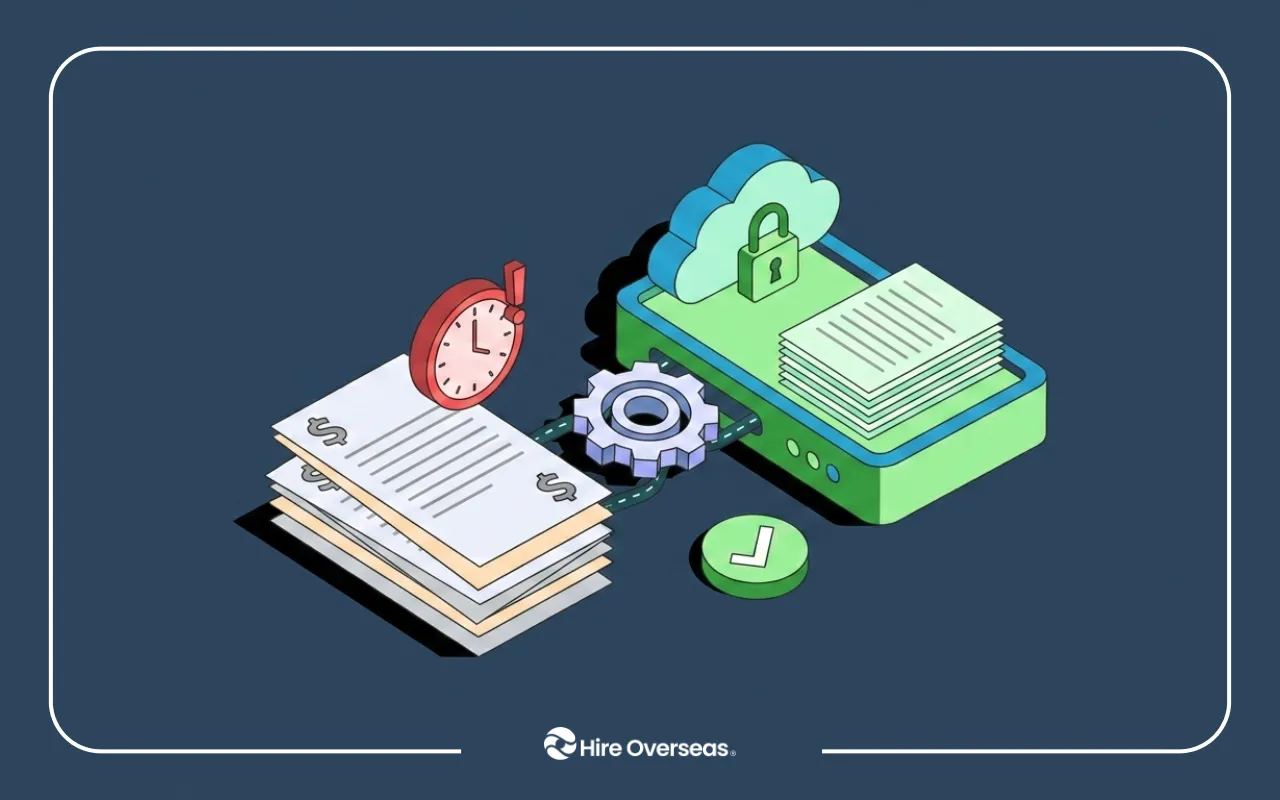
Most companies do not start looking for outsourced payroll services after a payroll crisis. In our experience, the smoothest transitions happen when businesses act before payroll becomes an operational risk. As companies grow, payroll often becomes more complex through workforce expansion, multi-state hiring, contractor management, and increasing compliance requirements. We've spoken with founders, HR leaders, and finance teams who realized payroll was still working, but it was demanding more time and oversight than before. One lesson we've consistently observed is that businesses rarely outsource payroll because calculations become difficult. They outsource payroll because growth changes everything surrounding payroll.
The Early Signs Payroll Is Becoming More Than a Finance Function
One of the more interesting patterns we've observed at Hire Overseas is that payroll complexity rarely arrives all at once. Most businesses do not suddenly decide to outsource payroll services. Instead, payroll gradually becomes more difficult to manage through a series of business decisions that seem reasonable at the time but collectively create new operational demands.
Workforce Growth Starts Creating New Payroll Requirements
One of the first signs often appears when headcount increases. A company hires additional employees. Contractors are brought in to support growth. New teams are formed across different departments. At first, payroll simply involves more people. Over time, however, workforce growth often introduces new reporting requirements, approval processes, classifications, and compliance considerations. Several companies we've spoken with discovered that payroll complexity increased much faster than employee count alone would suggest.
Hiring Across Locations Introduces New Compliance Considerations
Another common trigger is geographic expansion. A business hires a remote employee in another state. An organization begins building an offshore team in the Philippines. A growing company expands into new markets to access talent. What initially feels like a hiring decision often creates additional payroll responsibilities involving taxes, statutory benefits, reporting requirements, and labor regulations. One partner described this shift perfectly. Hiring the employee was easy. Managing everything that came after was where the complexity emerged.
If your business is in the process of expanding into the Philippines, this overview of hiring remote workers in the Philippines covers the specific employment structures and local compliance requirements you'll encounter from day one.
Payroll Starts Consuming More Leadership Time
One of the strongest signals is not a payroll error. It is leadership attention. We've spoken with startup founders who found themselves reviewing payroll reports every pay period. HR managers started balancing payroll administration alongside recruiting and employee relations. Finance leaders became increasingly involved in payroll compliance questions. Payroll may still be functioning correctly, but the amount of oversight required to keep it functioning continues to increase.
Payroll Requires Expertise Beyond Software
Many businesses successfully use platforms such as ADP, Gusto, Paychex, QuickBooks Payroll, or Rippling. The challenge is rarely the software itself. We recently had a discovery call with a company that had managed payroll internally for years without major issues. Payroll processing was running smoothly, but workforce complexity had begun increasing faster than internal processes could adapt. The company did not suddenly need different software. It needed additional payroll expertise and operational support.
The Business Is Growing Faster Than Payroll Processes
Perhaps the clearest sign is when payroll processes stop evolving at the same pace as the business. What worked for a team of ten may not work for a team of fifty. What worked in one location may not work across multiple states or countries. What worked when payroll was a monthly task may not work when payroll becomes intertwined with compliance, workforce planning, and operational management. In our experience, businesses that recognize these signals early are often better positioned to scale. Rather than waiting for payroll mistakes, compliance issues, or administrative bottlenecks to occur, they begin evaluating how payroll operations will support future growth.
That proactive mindset is one of the most common traits we've seen among organizations that successfully outsource payroll services before payroll becomes an operational risk.
The Hidden Risks That Grow Around Payroll Operations
One reason payroll challenges often catch businesses off guard is that the risks usually develop gradually. Unlike a missed sales target or a failed product launch, payroll problems often remain invisible until they affect employees, compliance obligations, or leadership time. By the time organizations recognize the impact, payroll has often evolved into a much larger operational responsibility than anyone anticipated.
Compliance Mistakes Become More Difficult to Avoid
As workforce complexity increases, so do compliance requirements. A growing business may suddenly need to manage:
- payroll tax filings
- overtime calculations
- employee classifications
- contractor classifications
- statutory benefits administration
- year-end reporting requirements
Each new employee, location, or workforce structure introduces additional variables. We've spoken with leaders who initially viewed payroll compliance as a routine administrative task. Over time, however, they realized that keeping up with changing requirements required far more attention than expected. The challenge was not processing payroll. The challenge was ensuring payroll remained compliant as the business evolved.
If you're managing a mix of employees and contractors across multiple locations, this breakdown of international payroll covers the specific tax withholding, currency, and classification variables that surface once you're running payroll across borders.
If your team is hiring across state lines, this guide to remote work laws by state covers the specific wage, tax nexus, and registration requirements that vary by jurisdiction and catch growing businesses off guard.
Payroll Errors Affect More Than Payroll
Many business processes can tolerate occasional mistakes. Payroll is rarely one of them.
When payroll errors occur, the consequences often extend beyond finance. Employees may lose confidence in internal processes. HR teams become responsible for resolving disputes. Finance teams spend time correcting records and addressing reporting issues. Leadership becomes involved in situations that could have been avoided through stronger payroll oversight. One operations leader described payroll to us as a trust function disguised as an administrative process. Employees may never notice when payroll runs smoothly, but they immediately notice when something is wrong.
Growth Can Expose Weak Processes
One of the most common patterns we've observed is that payroll processes often work perfectly until growth exposes their limitations. A system designed for a small team may struggle to support:
- multi-state employees
- international workers
- larger headcounts
- multiple pay structures
- expanding compliance requirements
The problem is rarely a single process failure. Instead, growth reveals that existing workflows were never designed to support the organization's current level of complexity.
Payroll Risk Often Appears as Operational Friction
Perhaps the most overlooked risk is operational friction. Payroll questions take longer to resolve. Approvals require more coordination. Compliance reviews become more frequent. Leadership spends increasing amounts of time discussing payroll-related issues. None of these challenges necessarily indicate that payroll is failing. However, they often signal that payroll is consuming more organizational resources than it should.
At Hire Overseas, we've found that many companies begin evaluating outsourced payroll services not because a major problem occurred, but because they recognize these patterns early. They understand that payroll risk is often easier to prevent than it is to fix.
The organizations that scale most successfully are usually the ones that strengthen payroll operations before payroll complexity starts slowing the business down.
For finance and HR leaders evaluating whether to move payroll off their plate entirely, this overview of payroll outsourcing covers what the transition typically involves, including how responsibilities are divided between your team and the provider during the handoff.
Why Growing Businesses Eventually Outsource Payroll Services
One misconception we've encountered is that companies outsource payroll because they can no longer process payroll internally. In reality, most businesses we speak with are still running payroll successfully when they begin evaluating outsourced payroll services.
Employees are getting paid. Payroll software is functioning. Reporting deadlines are being met. What changes is the amount of effort required to maintain those outcomes. As organizations grow, leaders often realize they are spending increasing amounts of time managing payroll operations rather than simply processing payroll. More approvals are required. Compliance questions become more frequent. Workforce structures become more complex. Administrative responsibilities continue expanding. At some point, payroll stops feeling like a recurring task and starts feeling like a function that requires dedicated expertise. While every organization is different, we've observed three major reasons businesses eventually decide to outsource payroll services.
1. Leadership Wants Payroll to Become Predictable Again
One of the most common themes we hear from founders, HR leaders, and finance teams is that payroll becomes increasingly difficult to predict as complexity grows.
New regulations emerge. Workforce structures evolve. Compliance requirements change. Questions that were once rare become routine. Many businesses choose to outsource payroll processing services because they want greater consistency and predictability. They want confidence that payroll administration, reporting, and compliance responsibilities are being managed by specialists whose primary focus is payroll.
The goal is not simply to reduce workload. The goal is to reduce uncertainty.
2. Internal Teams Are Pulled Away From Higher-Value Work
We recently spoke with an HR leader who described payroll as a responsibility that gradually expanded over time. What started as a manageable administrative task eventually became intertwined with onboarding, compliance reviews, employee questions, benefits administration, and reporting requirements. Payroll was not failing. It was consuming time that could have been spent on hiring, employee development, and workforce planning. This is a pattern we've observed repeatedly. Businesses often outsource payroll services because they want HR, finance, and leadership teams focused on growth rather than payroll administration.
3. Specialized Expertise Becomes More Valuable Than Ownership
Many organizations initially prefer managing payroll internally because it provides direct control. Over time, however, control becomes less important than expertise.
A growing company may encounter questions involving:
- employee classifications
- contractor classifications
- payroll tax obligations
- overtime calculations
- multi-state compliance
- international payroll requirements
Maintaining expertise across all of these areas can become difficult for internal teams whose responsibilities extend far beyond payroll. For many businesses, outsourcing becomes a practical way to access specialized payroll knowledge without building an entire payroll department internally. Across these three themes, the underlying pattern is the same: payroll needs to scale alongside the business.
Payroll is no longer simply about paying employees. It becomes connected to hiring plans, workforce expansion, compliance management, remote work strategies, and long-term operational planning. The businesses that scale most effectively often recognize that payroll infrastructure needs to evolve alongside the organization itself. Rather than waiting for payroll complexity to create operational challenges, they invest in the systems, expertise, and support needed to keep pace with growth.
That is often the point where outsourcing becomes less of a cost decision and more of a scalability decision.
How to Know You've Built an Operational Payroll System
Many growing businesses assume payroll is running smoothly because employees are being paid on time. While timely payroll is important, it's not necessarily a sign that the payroll function is operating efficiently at scale. One of the clearest indicators that a company has built an operational payroll system is that payroll no longer depends on constant leadership involvement to function correctly. In the early stages of growth, payroll often requires direct oversight from founders, finance managers, or HR leaders. Questions arise frequently. Processes are still being refined. Payroll administration demands attention because the systems supporting it are still evolving. As organizations mature, however, payroll begins operating differently. Employees are paid accurately and on time. Compliance obligations are met. Tax filings are completed. Questions are resolved efficiently. Payroll continues supporting the business without regularly requiring intervention from leadership.
Several companies we've worked with described this transition as a major milestone in their growth. Payroll stopped feeling like a recurring management responsibility and started functioning like a dependable operational system.
There are usually a few signs that this shift has occurred:
- Payroll runs consistently without last-minute issues or manual workarounds.
- Employees receive timely answers to payroll-related questions.
- Compliance requirements are handled proactively rather than reactively.
- Leadership is informed about payroll performance without needing to manage payroll directly.
- Growth, hiring, and workforce changes can be accommodated without disrupting payroll processes.
When these conditions are in place, payroll becomes less visible across the organization.
Ironically, that is often when it becomes most valuable. Not because it is generating revenue or driving strategy, but because it allows leadership, HR, and finance teams to focus their attention elsewhere. The business gains confidence that payroll is being managed correctly without requiring constant oversight. In our experience, the most scalable payroll systems are not necessarily the most sophisticated. They are the ones leaders rarely need to think about.
For organizations working to build this same reliability across their broader finance function, this guide on how businesses outsource financial record-keeping without losing visibility or control explains how clean books and structured financial oversight work together to give leadership the confidence to focus on growth rather than administrative review.
Because The Best Payroll Systems Are the Ones Nobody Notices
The best payroll systems are the ones nobody notices because they allow businesses to focus on growth instead of administration. When payroll runs smoothly, employees are paid accurately, compliance obligations are met, and leadership is free to focus on higher-value priorities. Payroll supports the business without demanding constant attention.
That is why many companies choose to outsource payroll before problems emerge. The goal is not simply to process payroll more efficiently. It is to prevent payroll from becoming an operational risk as the business grows.
By outsourcing early, organizations can reduce administrative burden, strengthen compliance, and build processes that scale alongside their workforce.
In that sense, the best payroll systems are not the ones that attract attention. They are the ones that quietly provide the stability and confidence businesses need to keep moving forward.
If you're ready to build a payroll function that supports growth without becoming a recurring management challenge, book a discovery call with Hire Overseas and explore how dedicated payroll support can help create a more reliable and scalable operation.
