
Hiring Remote Talent Overseas Checklist: The Hire Overseas Insider Guide for Startups
Most startups approach offshore hiring like a cost experiment. Insiders know better. Hiring remote talent overseas works when it is treated as an operating system, not a sourcing shortcut.
This hiring remote talent overseas checklist reflects how experienced operators actually build offshore teams that last. It is the internal trade checklist we use when startups come to Hire Overseas after failed offshore hires, misaligned agencies, or compliance scares.
1. Define the Role for Offshore Reality, Not Local Assumptions
Before you hire offshore employees, the role must survive without constant clarification. Offshore work exposes unclear expectations faster than local hiring because distance removes informal fixes.
Pressure-test whether the role is designed for execution or decision-making. Decision-heavy roles can work offshore, but only after strong systems are in place. Most early offshore wins come from execution-focused roles with defined outputs.
Roles that succeed when hiring talent from abroad share three traits:
- Work can be broken into clear deliverables
- Processes can be documented and followed
- Daily real-time dependency on leadership is minimal
If success cannot be explained in weekly outcomes, offshore hiring will surface that weakness immediately.
2. Choose the Right Country Based on Talent Systems, Not Cost
Cost matters, but it should never be the first filter. Countries succeed as offshore hubs because of talent systems, not wage levels.
Strong offshore markets have:
- Long-standing exposure to US or EU companies
- Cultural alignment with deadlines, accountability, and feedback
- Education pipelines aligned with service, technical, or administrative work
When you hire offshore employees, prioritize depth of talent over headline rates. Talent density ensures replacements are available, skills are consistent, and hiring scales predictably.
Cheap markets without structure often result in higher churn, repeated retraining, and management fatigue that erodes any cost savings.

3. Decide How You Will Hire Offshore Employees
How you hire offshore employees determines who carries risk and responsibility.
The three common paths are:
- Direct hiring through your own foreign entity
- Independent contractor arrangements
- Offshore staffing or employer-of-record partnerships
Your choice should be driven by:
- Your tolerance for compliance risk
- Your need for continuity and replacements
- Your capacity to manage legal and operational overhead
If hiring remote talent overseas is central to your growth strategy, infrastructure matters more than speed. The fastest hire is often the most expensive one long term.
If this is your first remote or offshore team, structure matters more than speed.
Read more: The 2025 Guide to Hiring Your First Remote Team
[blog-cta_component]
4. Validate Skills Using Work Samples, Not Resumes
Resumes lose meaning across borders. Titles, education, and tenure do not translate consistently.
When hiring talent from abroad, work samples reveal what resumes cannot. Paid test tasks simulate real conditions and show how candidates think, execute, and communicate.
Your checklist should validate:
- Accuracy and attention to detail
- Familiarity with your tools and workflows
- Ability to follow written instructions
- Openness to feedback and iteration
Offshore success depends on execution reliability. Credentials do not complete tasks. Systems and discipline do.
5. Test Communication Under Real Conditions
Most offshore hiring failures stem from communication gaps, not skill shortages.
Before you hire offshore employees, test communication in the same environment the role will operate in. Live calls reveal clarity and confidence. Async tests show writing ability, responsiveness, and judgment.
Strong remote talent:
- Asks clarifying questions early
- Documents decisions and progress
- Escalates issues before they become blockers
If communication feels strained during hiring, it will not improve under deadlines or workload pressure.
6. Confirm Legal, Tax, and Compliance Coverage
This is the most skipped step and the most dangerous one.
Your hiring remote talent overseas checklist must clearly define:
- Worker classification and local labor compliance
- Ownership of intellectual property
- Data security and confidentiality protections
- Tax and payroll responsibilities
Hiring talent from abroad without clear compliance ownership exposes your company to misclassification claims, penalties, and IP risk. If no one on your team can explain how compliance is handled, you are not ready to hire.
7. Design Onboarding Before the Start Date
Offshore hires succeed or fail in their first month. Improvised onboarding creates confusion and disengagement.
Before day one, ensure:
- Workflows are documented or actively documented during onboarding
- Communication cadence is established
- Ownership of onboarding is clearly assigned
Your checklist should include:
- Tool and system access
- Clear success metrics for the first 30 days
- Weekly feedback loops to correct course early
Offshore talent does not need closer supervision. They need better structure.
8. Set Decision Rights and Escalation Boundaries Early
Offshore teams slow down when decision authority is unclear. Many capable hires underperform simply because they do not know when to act and when to escalate.
Before work begins, define:
- What decisions the role can make independently
- What requires approval
- What issues must be escalated immediately
Clear decision boundaries prevent hesitation, reduce back-and-forth, and increase ownership. Offshore performance improves when talent knows they are trusted to act within defined limits.\
9. Prepare Your Internal Team for Offshore Collaboration
Offshore hiring fails as often because of internal behavior as offshore execution.
Before adding offshore employees, align your internal team on:
- Clear written communication expectations
- Constructive feedback standards
- Respect for time zones and async workflows
When local teams rely on informal context or last-minute requests, offshore teams struggle. Offshore success requires internal discipline, not just external talent.
Most offshore failures are not skill issues, they are remote work system failures.
Read more: The Most Common Remote Work Challenges (and How Teams Fix Them)
10. Plan for Retention and Continuity
Hiring remote talent overseas is not transactional. It is cumulative.
Retention improves when offshore employees have:
- Stable roles
- Predictable expectations
- Clear growth or skill expansion paths
Your checklist should also plan for:
- Backup coverage
- Replacement timelines
- Process and knowledge documentation
Turnover offshore becomes expensive only when systems are weak. With clear processes, continuity is manageable and predictable. Continuity is a systems problem, not a loyalty problem.
Reliability offshore is not about resumes — it’s about systems, continuity, and accountability.
Read more: How to Hire a Reliable Virtual Assistant
11. Protect Offshore Roles From Scope Creep
Offshore roles fail fastest when they quietly become catch-all positions. What starts as a focused execution role often turns into a dumping ground for low-priority, unclear, or urgent tasks as the company grows.
Scope creep is especially damaging offshore because it erodes accountability and quality at the same time. When responsibilities expand informally, performance becomes harder to measure and expectations drift.
To prevent this, your checklist should enforce role discipline:
- Clearly define what the role owns and what it does not own
- Introduce new responsibilities intentionally and document them
- Monitor workload expansion during growth phases and hiring transitions
Strong offshore teams scale when roles remain stable and clearly bounded. Quality drops fastest when tasks are added casually without revisiting role design, success metrics, or capacity. Deliberate scope control preserves execution speed, output quality, and long-term retention.
12. Measure Output, Not Hours
Micromanagement destroys offshore leverage.
When you hire offshore employees, performance should be evaluated by:
- Deliverables completed
- Quality standards met
- Responsiveness to feedback and changes
Outcome-based management builds trust, encourages ownership, and allows teams to scale without constant oversight. Time tracking measures activity, not progress.
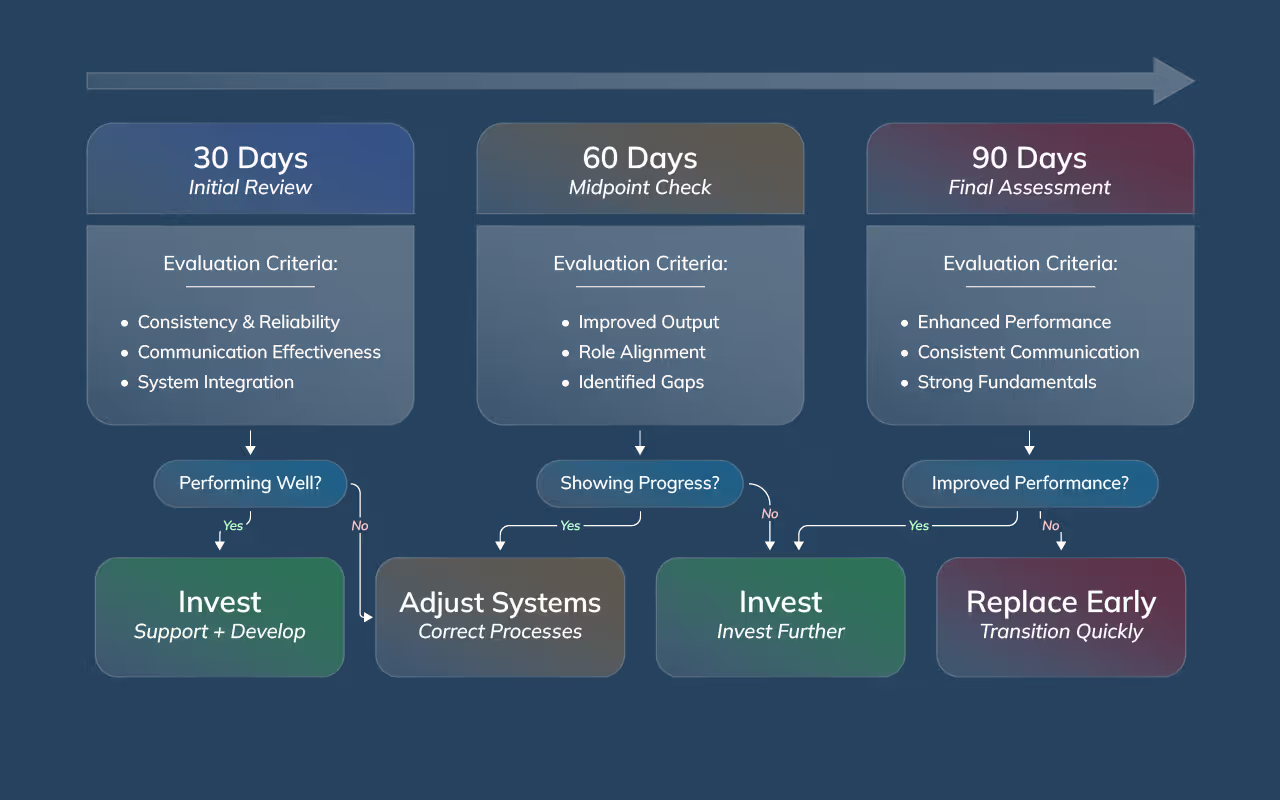
13. Create a 90-Day Offshore Success Review
Most offshore hires do not fail immediately. They fail slowly because performance issues are tolerated without structure and decisions are delayed until frustration builds.
A 90-day review creates an objective checkpoint before problems compound.
At 30, 60, and 90 days, review:
- Consistency and reliability of output
- Communication effectiveness in live and async environments
- Process fit within your existing systems
- Gaps in role clarity, ownership, or expectations
This review should lead to a clear decision:
- Improve systems if execution is strong but workflows are weak
- Adjust role scope if responsibilities were misaligned
- Invest further when performance and communication are consistent
- Replace quickly and cleanly when fundamentals are not improving
Offshore hiring works best when performance decisions are made early and systematically, not emotionally after months of uncertainty.
14. Review and Optimize Quarterly
Offshore teams improve when treated as evolving systems.
Every quarter:
- Reassess role scope and workload
- Identify process bottlenecks
- Improve documentation and workflows
Hiring talent from abroad works best when systems mature alongside the team. Static roles and outdated processes create friction that compounds over time.
How Hire Overseas Turns Offshore Hiring Into a System
Most startups do not fail at offshore hiring because talent is unavailable. They fail because they try to build legal, hiring, and operational infrastructure one piece at a time while scaling the business.
Hire Overseas exists to remove that friction.
We do not just help you hire offshore employees. We operationalize every step in this checklist so offshore hiring becomes predictable instead of fragile.
Here is what changes when startups work with Hire Overseas:
- Roles are pressure-tested for offshore readiness before recruiting begins
- Talent is sourced from proven markets aligned with US startup expectations
- Hiring paths are structured to reduce compliance risk and ownership ambiguity
- Candidates are vetted for execution, communication, and system adherence
- Onboarding is structured with clear expectations, cadence, and success metrics
- Decision rights, scope boundaries, and performance standards are defined early
- Retention, continuity, and replacement planning are built into the model
- Performance is reviewed systematically, not reactively
Instead of managing compliance details, misalignment, scope creep, and turnover risk, founders focus on outputs and growth.
With Hire Overseas, hiring remote talent overseas becomes a repeatable operating system. Compliance is handled, execution is measurable, and teams scale without breaking processes.
Offshore hiring stops being a gamble and starts functioning like infrastructure.
Offshore Hiring Works When It Is Built Like Infrastructure
Hiring remote talent overseas is not a tactic. It is an operating decision that compounds for better or worse depending on how it is built.
Startups that struggle offshore usually do not lack access to talent. They lack role clarity, system discipline, compliance structure, and performance checkpoints. Those gaps stay hidden early and become expensive later.
This hiring remote talent overseas checklist exists to surface those risks before they slow execution. When roles are designed for offshore reality, markets are chosen for maturity, expectations are explicit, and performance is reviewed systematically, offshore teams become a durable growth lever.
The companies that win offshore do not hire faster. They hire with structure. They treat offshore talent as part of their operating system, not an experiment to manage reactively.
Ready to Build Offshore Hiring the Right Way?
If you want to turn offshore hiring into a repeatable system instead of a trial-and-error process, Hire Overseas can help.
We work with startups that are ready to build offshore teams with clear roles, built-in compliance, and performance structures that scale.
Book a demo to see how Hire Overseas operationalizes this checklist for your business.
FAQs About Hiring Remote Talent Overseas
Is hiring remote talent overseas actually cheaper than hiring locally?
Hiring overseas is typically 30–70% more cost-efficient than U.S.-based hiring for equivalent execution roles, but the real savings come from scalability and retention—not hourly rates. Companies that optimize systems and continuity see compounding returns over time, while cost-only approaches often lose savings to churn and retraining.
Can early-stage startups hire remote talent overseas, or is this only for scaling companies?
Early-stage startups can hire overseas successfully if the role is execution-focused and well-scoped. Founders who attempt offshore hiring before defining workflows or outputs often struggle. Offshore hiring works best when it supports focus—not when it substitutes for unclear strategy.
Do offshore employees work full-time or part-time?
Offshore talent can be hired full-time, part-time, or project-based, depending on the hiring model used. Full-time roles typically offer better continuity, accountability, and retention—especially when offshore hiring is part of a long-term operating strategy.
Is it risky to give offshore employees access to company systems and data?
Risk depends on process design, access controls, and contracts, not geography. With proper data permissions, IP protection, and security protocols, offshore teams can operate as safely as local ones. Risk increases only when safeguards are informal or undocumented.
What is the difference between offshore staffing agencies and employer-of-record (EOR) partners?
Offshore staffing agencies focus on sourcing and placing talent, but employment, payroll, and compliance responsibility usually remain with the hiring company.
Employer-of-record (EOR) partners act as the legal employer, handling payroll, taxes, benefits, and local labor compliance to reduce risk.
Many startups fail by treating these models as interchangeable. Staffing solves for talent access; EORs solve for employment infrastructure.
Hire Overseas combines both—sourcing vetted offshore talent and managing compliance, payroll, and ongoing workforce operations—so startups can scale offshore teams without fragmented vendors or hidden risk.


Unlock Global Talent with Ease
Hire Overseas streamlines your hiring process from start to finish, connecting you with top global talent.
Unlock Global Talent with Ease
Hire Overseas streamlines your hiring process from start to finish, connecting you with top global talent.
