


AI video creation is accelerating fast, but AI video governance is becoming the real bottleneck. Google VEO-3 can generate cinematic footage in minutes, but producing the asset is only step one. The real challenge is ensuring the video is trusted, machine-readable, policy-safe, and fully visible across Google’s search and AI discovery systems.
This is why AI-forward companies are hiring a new kind of talent: the Google VEO-3 Specialist.
For teams scaling AI video, this role is no longer optional—it’s essential.
What Is a Google VEO-3 Specialist?
A Google VEO-3 Specialist ensures AI-generated videos are authentic, machine-readable, compliant, and fully optimized for search visibility across Google’s AI ecosystem. They manage the technical frameworks—metadata, provenance, schema, tagging, and policy alignment—that determine whether a VEO-3 video is trusted, correctly indexed, and surfaced across AI-driven discovery systems.
Who Needs This Role Most?
You don’t need a VEO-3 Specialist for occasional experiments—you need one when AI video becomes a core part of your production pipeline. The companies that adopt this role first are typically:
- teams producing 20+ AI-generated videos per month
- regulated industries where accuracy, attribution, and compliance are mandatory (finance, health, legal)
- brands operating across multiple regions or languages that require consistent metadata and schema
- organizations adopting AI video at scale and facing operational, compliance, or indexing bottlenecks
If any of these match your current workflow, a VEO-3 Specialist quickly becomes a necessity—not a luxury.
Explore how Google VEO-3 stacks up against Runway ML for AI-driven video production.
Why the Google VEO-3 Specialist Role Exists
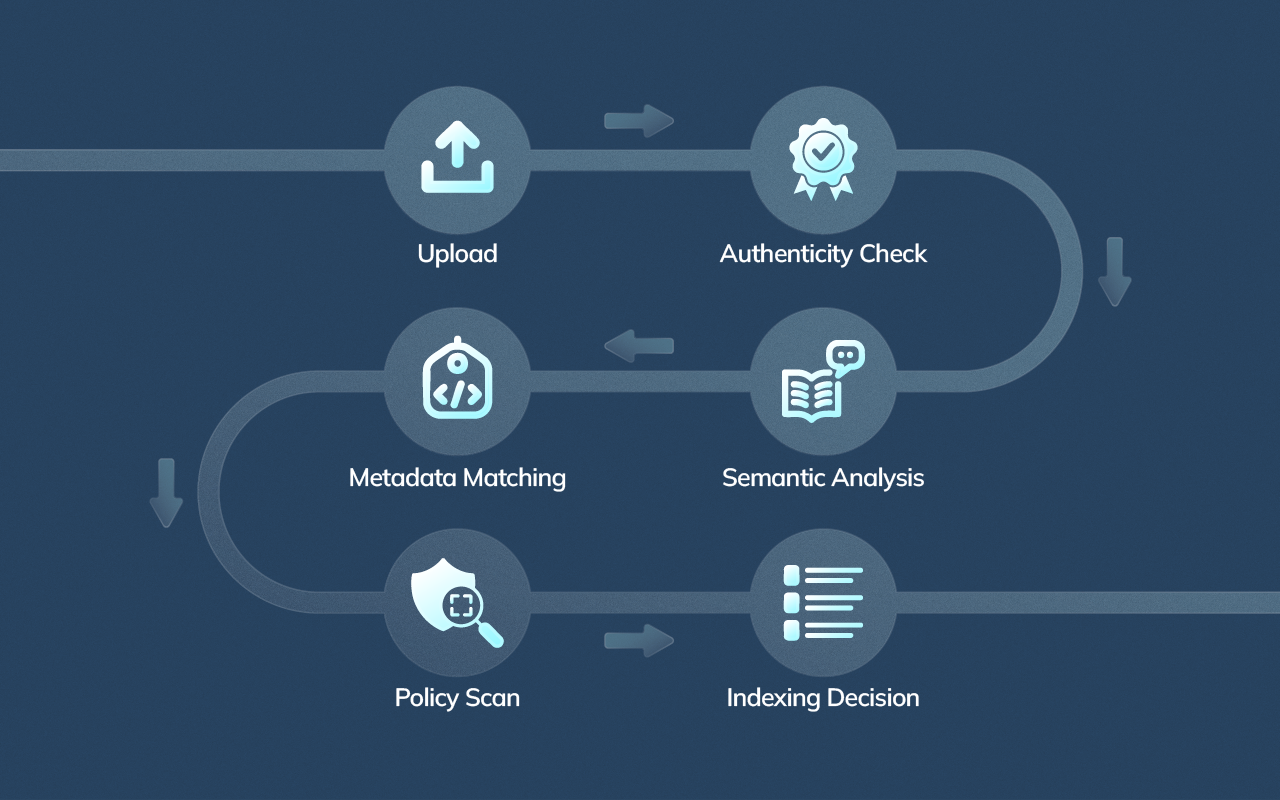
VEO-3 makes video creation fast, but Google’s evaluation systems are far more demanding than most teams realize. The moment an AI-generated video is uploaded, Google runs it through multiple layers of verification, semantic interpretation, and policy checks. These layers determine whether a video is trusted, recommended, indexed correctly, or suppressed.
Most companies don’t have anyone who understands how these systems work — which is exactly why the Google VEO-3 Specialist role emerged.
Here’s what makes the role necessary:
Google now requires proof that AI-generated videos are authentic and verifiable
Google doesn’t simply take a video at face value. It expects clear markers that identify:
- who created the video
- how it was generated
- which model produced it
Without the right provenance data and watermarking, videos may be restricted or shown less often.
A VEO-3 Specialist ensures every file meets Google’s authenticity standards so the content is trusted, not flagged.
AI-generated videos must align with a strict metadata and semantic structure
Google compares the video’s content against:
- its captions
- its metadata
- its structured data
- its narrative or prompt intent
If the system detects inconsistencies, it lowers ranking or misclassifies the video.
A VEO-3 Specialist designs metadata frameworks that reinforce what the video actually depicts, eliminating mismatch penalties.
Google’s indexing now depends on multimodal AI interpretation—not keywords
Traditional SEO is no longer enough. Google’s models “read” each video by analyzing:
- objects
- motion
- relationships
- lighting
- scene transitions
- tone and context
Small technical inconsistencies can change how the video is categorized. A VEO-3 Specialist ensures the video is machine-readable, predictable, and indexable across all AI surfaces.
Compliance, safety, and disclosure rules are evolving faster than teams can keep up
AI synthetic media requires:
- proper disclosure
- policy alignment
- safety classification
- sensitive-topic handling
Most creative teams aren’t trained in AI regulatory standards.
A VEO-3 Specialist prevents videos from being suppressed due to policy violations — which often happen unintentionally.
Discoverability depends on structured data that matches Google’s AI scoring rules
Visibility is no longer just about uploading assets. Google requires:
- schema
- time-coded entities
- scene descriptors
- technical metadata fields
If these are missing, the video may not appear in recommended feeds or AI Overviews.
A VEO-3 Specialist builds the structured data layer that determines whether your video is discoverable at all.
Production teams need someone who can scale AI video operations without breaking consistency
As companies produce more AI-generated videos, they face new operational problems:
- inconsistent metadata
- unclear provenance
- uneven quality
- manual tagging errors
- compliance gaps
- unpredictable indexing results
A VEO-3 Specialist builds repeatable workflows so the entire pipeline stays stable, compliant, and scalable.
The bottom line
Google VEO-3 created a new type of video content and Google’s evaluation systems created a new type of talent. A Google VEO-3 Specialist exists because AI video is no longer just about what you create.
It’s about whether Google can:
- trust it
- understand it
- classify it
- index it
- surface it
Without a specialist overseeing these signals, even the best-looking VEO-3 video can remain invisible.
Read more about the evolution of AI video workflows in our Google VEO-3 creation guide.
The Core Responsibilities of a Google VEO-3 Specialist
A Google VEO-3 Specialist is not a creative editor, a prompt designer, or a video producer.
They are the technical architect responsible for ensuring AI-generated video is trusted, interpretable, compliant, and discoverable across Google’s ecosystem.
Below is a deeper look at what they actually do and why each function is essential.
Authenticity & Provenance Setup
Google increasingly requires AI-generated videos to prove their origin.
This prevents misinformation, deepfake misuse, and unverified synthetic content from being ranked or widely distributed.
- A VEO-3 Specialist ensures every video contains:
- AI video watermarking embedded correctly
- provenance metadata that identifies creation source
- model attribution and disclosures
- integrity markers signaling the video has not been altered deceptively
Why this matters
Without verified origin signals, videos may be flagged, restricted, or ranked lower. Authenticity has become a trust requirement—not an optional enhancement.
Metadata Architecture & Semantic Alignment
Google now evaluates whether your metadata and your video “say the same thing.”
Because VEO-3 content is generated through prompts, inconsistencies often arise between:
- what the video shows
- what the metadata claims
- how captions describe the action
- what structured data asserts
A VEO-3 Specialist engineers metadata frameworks where:
- keywords align with scenes
- entities map to visual objects
- narrative intent is reflected in schema
- timestamps match actions and transitions
Why this matters
Even slight inconsistencies reduce visibility. Semantic alignment prevents indexing errors and ensures Google clearly understands the video’s purpose.
AI Video Tagging for Machine-Learning Interpretability
Google does not interpret video like a human.
Its AI models analyze:
- object relationships
- lighting logic and depth
- motion physics
- emotional tone
- environmental context
- how scenes connect
A VEO-3 Specialist translates these elements into coherent, machine-readable tags, ensuring Google’s systems interpret the video precisely.
Why this matters
This is the layer editors and marketers usually miss.
Incorrect or missing tags lead to misclassification, which breaks discoverability.
Structured Data for AI-Driven Search Visibility
Visibility now depends on how well your video integrates with Google’s structured data requirements.
A VEO-3 Specialist creates:
- schema markup for every asset
- entity-rich descriptions that mirror visual content
- time-coded metadata defining key moments
- tight consistency between captions, structured data, and visuals
Why this matters
Structured data is how Google determines:
- the topic
- the context
- the relationships
- the eligibility for AI Overview inclusion
- the suitability for search results or Discover
- the ranking value of each video
Without schema and strong structuring, videos struggle to appear anywhere meaningful.
Compliance, Risk Prevention & Brand Safety
AI-generated video introduces entirely new compliance challenges. Companies must meet standards for:
- transparent disclosure
- synthetic content labeling
- safe content classification
- industry-specific compliance (finance, health, legal)
- misinformation prevention
A VEO-3 Specialist monitors these evolving requirements and integrates safeguards into the production pipeline.
Why this matters
Non-compliant AI video is quickly suppressed or removed.
Brand safety is not optional—Google enforces it algorithmically.
Pipeline Optimization for Scalable AI Video Production
As companies adopt VEO-3, output volume grows exponentially.
Without a standardized pipeline, teams face chaos—misaligned metadata, inconsistent branding, compliance gaps, or bottlenecked QA.
A VEO-3 Specialist builds operational systems including:
- version-controlled prompt libraries
- metadata governance rules
- automated authenticity checks
- scene-to-schema mapping workflows
- quality gates for AI compliance and safety
- publishing standards that ensure cross-platform consistency
Why this matters
It transforms VEO-3 from an experimental tool into a reliable production engine that can scale across campaigns, teams, and markets.
How This Role Differs From Editors or Prompt Engineers
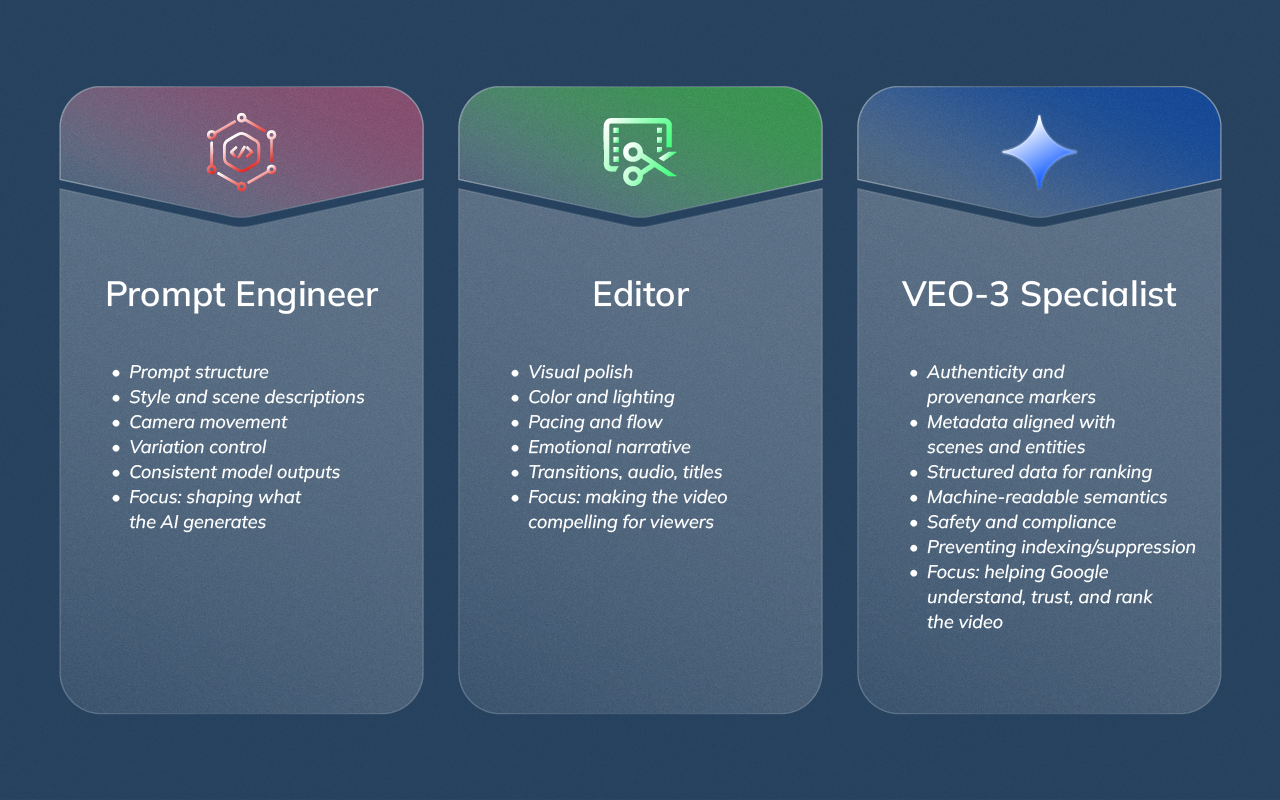
Most teams assume a Google VEO-3 Specialist is just another editor or prompt engineer with a new title. It’s not.
This role emerged because AI-generated video introduced new governance, verification, and indexing requirements that creative teams are not trained to handle.
Here’s the difference with full clarity:
A VEO-3 Editor: Improves the final viewing experience
- They focus on human perception:
- visual polish
- color and lighting adjustments
- pacing and flow
- narrative emotional impact
- transitions, audio, titles, overlays
Their job is to make the video compelling. But they do not manage how Google understands the video.
A Prompt Engineer: Shapes the initial AI output
They specialize in:
- prompt structure
- style, camera movement, and scene descriptions
- variation control
- generating consistent outputs from the model
They influence what the AI produces. But their work ends before the video enters Google’s evaluation systems.
A Google VEO-3 Specialist: Ensures the video survives Google’s verification and ranking layers
They operate in the technical layer beyond creation and editing:
- setting up authenticity and provenance markers
- aligning metadata with scenes, entities, and actions
- encoding structured data that boosts ranking
- making videos machine-readable and semantically interpretable
- ensuring compliance with synthetic media safety standards
- preventing indexing errors or suppression
- maintaining schemas and production pipelines
Where editors and prompt engineers focus on what the audience sees, the VEO-3 Specialist focuses on what Google’s AI systems see — and whether the video earns trust, visibility, and discoverability.
Why this distinction matters for companies
As the volume of AI-generated video increases, the risk of:
- misclassification
- suppressed visibility
- incorrect intent detection
- non-compliance flags
- broken ranking signals
also increases. Creative teams are not equipped to solve these issues, and marketing teams do not understand the underlying technical requirements.
That’s why the VEO-3 Specialist role exists — to safeguard the search performance of AI-generated video.
Read more: See how a dedicated VEO-3 editor transforms AI video quality and trust signals.
Hire Overseas Insider: How Companies Actually Hire a Google VEO-3 Specialist
Most companies can generate AI video, but almost none have internal expertise in:
- AI video metadata engineering
- authenticity and provenance verification
- structured video schema design
- multimodal tagging for machine-readability
- synthetic media compliance and disclosure
- Google’s trust and indexing signals
This skills gap is why companies partner with Hire Overseas — a recruiting firm built specifically for AI-forward roles that require technical rigor, policy awareness, and operational clarity.
Here’s what the hiring process looks like behind the scenes:
1. Role Blueprinting: Defining the Technical Scope With Precision
Most employers come in saying “we need someone who understands VEO-3.”
But that could mean 50 different things.
Hire Overseas clarifies the exact responsibilities the role must own:
- metadata architecture and schema systems
- authenticity and watermark governance
- prompt-to-metadata alignment workflows
- multimodal tagging frameworks
- structured data mapping for search visibility
- compliance policies for synthetic media
- operational standards for scaling video pipelines
This prevents hiring the wrong profile—like a creative editor or prompt designer—when what’s truly needed is a technical governance operator.
2. AI-Forward Sourcing Across Specialized Global Talent Markets
VEO-3 Specialists are rare. So Hire Overseas doesn’t rely on typical creative or marketing talent pools. Instead, sourcing is concentrated in countries where technical adaptability, English fluency, and AI workflow experience are consistently strong:
- Philippines – exceptional metadata operators, structured content specialists, digital compliance talent
- South Africa – strong analytical and governance capabilities, high English proficiency
- LATAM – robust technical backgrounds with marketing–SEO crossover skills
- Sri Lanka – disciplined metadata and QA specialists with rigorous detail orientation
- Nigeria – rapidly growing AI-literate workforce with strong data governance skills
- India – deep bench of schema, data modeling, and ML-aware talent
While these regions dominate the hiring pipeline, Hire Overseas also sources globally for niche expertise when needed.
The goal is not geography — it’s precision: talent that understands AI systems, not just AI tools.
3. Technical Vetting: Proving They Understand Google's Evaluation Logic
Traditional interviews don't work for this role.
Hire Overseas uses scenario-based assessments that measure a candidate’s ability to work inside Google’s ecosystem.
Candidates must demonstrate competence in:
- multimodal tagging and semantic mapping
- metadata modeling across time-coded events
- schema markup built specifically for video entities
- using authenticity and provenance tools
- aligning structured data with narrative intent
- correcting videos Google misclassifies
- enforcing disclosure and safety requirements
- preventing trust-signal failures that suppress ranking
This ensures every hired specialist can operate at a level that protects visibility, compliance, and trust from Day 1.
4. Real-World Assessments: Work Samples Evaluated by Technical Recruiters
Instead of generic “bootcamps,” candidates complete real-world assignments modeled on the exact work they will perform:
- rewrite metadata sets to fix semantic inconsistencies
- design schema for a 45-second VEO-3 clip
- tag scene transitions using multimodal logic
- diagnose why a video would be suppressed or mistrusted
- generate an authenticity pipeline for a branded content library
These outputs are evaluated by technical recruiters trained in AI metadata, schema engineering, and content authenticity standards — not general HR screeners.
Only candidates who can perform real tasks at production level move forward.
5. Seamless Integration Into Creative, Marketing, or Product Teams
Once hired, a Google VEO-3 Specialist plugs directly into operational pipelines, typically owning:
- AI video metadata systems
- structured data and schema governance
- authenticity and provenance workflows
- content compliance reviews
- indexing diagnostics
- technical QA for large-volume video production
They sit at the intersection of:
- creative (ensuring visual intent matches metadata)
- marketing (ensuring videos remain discoverable)
- SEO/SEM (ensuring Google can interpret content)
- compliance (ensuring synthetic media rules are followed)
- analytics (measuring performance beyond views)
This frees creators to focus on storytelling and frees leadership to focus on outcomes while the Specialist safeguards visibility, accuracy, and compliance.
The Real Reasons Why Companies Choose Offshore VEO-3 Specialists
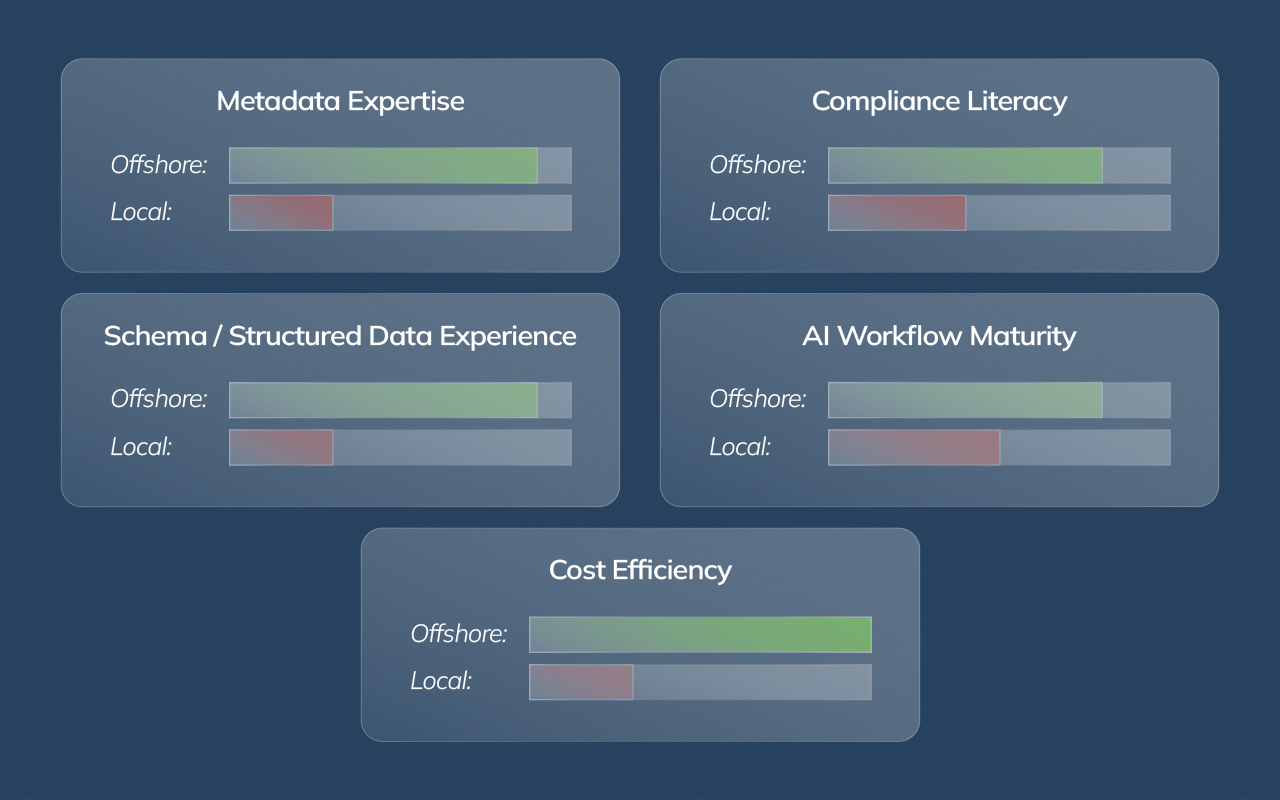
The old narrative (“offshore is cheaper”) is outdated and incomplete.
Companies choose offshore VEO-3 Specialists because the technical skill sets needed for AI video governance are emerging fastest in global markets—not locally.
Here’s what truly drives the demand:
Strong metadata and compliance talent pools
Philippines, India, Sri Lanka, Nigeria, and South Africa already excel in structured content work, annotation, and digital compliance — the exact foundations VEO-3 governance requires.
Local markets lack synthetic media expertise
AI provenance, watermarking, schema-rich video optimization, and multimodal tagging are still niche skills in the U.S. and Europe. Offshore specialists have been doing this type of work for years.
Faster adoption of AI-first workflows
Offshore professionals often have direct experience in ML annotation, AI-assisted production, and platform safety — giving them a head start over traditional creative hires.
Ability to build full AI video pipelines
Offshore hiring lets companies scale metadata teams, compliance units, structured data groups, and QA layers — not just fill one role.
Cost savings are secondary to capability
Lower cost (40–70%) helps, but companies choose offshore because the technical skill sets for AI video governance already exist there.
Discover how marketers are using Google VEO-3 to boost visibility, engagement, and search performance.
Visibility, Credibility, and Performance: What Only a VEO-3 Specialist Can Unlock
AI video creation is accelerating, but Google’s expectations are accelerating faster. Accuracy, authenticity, structured metadata, and machine readability now determine whether a VEO-3 video gains traction—or disappears into the noise.
Creative teams can generate remarkable content.
But only a VEO-3 Specialist ensures that content is:
- trusted by Google’s verification systems
- indexed correctly across search surfaces
- aligned with metadata and scene semantics
- compliant with emerging AI policies
- fully optimized for long-term visibility and performance
- This is the difference between producing a video and producing a video that wins.
If your organization wants a VEO-3 pipeline that is future-proof, discoverable, and built for scale, now is the moment to invest in the talent that makes AI video work at the highest level.
Work with pre-vetted VEO-3 Specialists trusted by high-growth, AI-forward companies through Hire Overseas.
Book a personalized consultation today.
FAQs About Google VEO-3 Specialists, AI Video Governance & Hiring Best Practices
Is a VEO-3 Specialist necessary if our team already has strong editors and prompt engineers?
Yes. Editors and prompt engineers optimize for human perception and AI generation, but neither owns the technical layer Google evaluates: provenance markers, semantic metadata, schema alignment, machine readability, disclosure requirements, and safety classification. A VEO-3 Specialist ensures the content is trusted, indexable, and policy-aligned — outcomes no creative role is trained to deliver.
How do VEO-3 Specialists keep AI-generated videos compliant with emerging global regulations?
They implement workflows for synthetic-media disclosure, watermark governance, provenance tracking, and ongoing updates based on Google and regulatory frameworks. They also classify content for risk, ensure proper labeling, and maintain audit-ready documentation. As compliance standards evolve monthly, the Specialist acts as the team’s regulatory buffer.
What happens if AI videos are uploaded without proper provenance or metadata structure?
Google may:
- misclassify the video
- suppress it in feeds
- exclude it from AI Overviews
- flag it for missing or incorrect disclosure
- reduce trust signals that influence ranking
Lack of metadata integrity often results in invisible videos, even if the creative output is high quality.
Can a VEO-3 Specialist improve performance for existing videos already published?
Yes. They can audit your library and fix:
- semantic mismatches
- metadata inconsistencies
- incorrect schema
- missing disclosure indicators
- suppressed or misindexed assets
Many companies recover 30–70% visibility on videos previously suppressed by Google once a specialist corrects the foundational signals.
Are offshore VEO-3 Specialists as effective as local hires?
Yes, in many cases, more effective. Countries like the Philippines, South Africa, India, Sri Lanka, and LATAM have deep talent pools in metadata architecture, AI annotation, digital compliance, and structured content — the exact skill sets VEO-3 governance requires. Companies choose offshore not for cost savings, but for technical maturity and operational speed.
Can a VEO-3 Specialist help build an end-to-end AI video pipeline?
Absolutely. Beyond optimization, they architect systems for:
- version-controlled prompt libraries
- metadata governance rules
- automation of provenance and safety checks
- scalable schema frameworks
- quality gates for compliance and trust
This transforms AI video from a creative experiment into an enterprise-grade production engine.